GardenShare

GardenShare

Saturday, September 30, 2017

Another student joins the team for the semester

Name: Corinna Pilcher

Hometown: Colchester, Vermont

Role at GardenShare: Volunteer

How long?: September – December 2017

Why I do what I do: I’m working with GardenShare as an additional learning experience with my class on societal change. I love GardenShare’s mission of strengthening the region’s food system to help both the farmers and those who need food assistance, with healthy food at the center. I look forward to helping this mission however I can in the four months I’m here.

Role outside of GardenShare: I’m a student at St. Lawrence University.

Hobbies: I love to travel, discuss current events, learn new things, and go on adventures.

What one word would you use to describe yourself? Inquisitive.

Favorite book: Margaret Atwood’s The Handmaid’s Tale.


Last read: Slaughterhouse Five by Kurt Vonnegut.

Friday, September 29, 2017

FOOD STAMPS--A HISTORY LESSON AND BIPARTISAN MODEL


Forty years ago--September 29,1977--President Carter signed into law the landmark 1977 Food Stamp Act, setting the framework for today’s Supplemental Nutrition Assistance Program. The 1977 law and its bipartisan roots both were years in the making. Food stamps began as a pilot program in 1961 and was converted to permanent status in 1964, but it wasn’t yet a nationwide program and wasn’t doing enough to address hunger. Tens years later the program served the whole nation. When President Ford sought in 1975 to cut food stamp benefits sharply by regulation, Congress passed legislation to block the measure by bipartisan, veto-proof margins. The Food Stamp Act that Carter signed in 1977, which passed Congress with bipartisan support, included the most far-reaching improvements in the program’s history. It eliminated the “purchase requirement” — that recipients must pay cash to purchase their food stamps (for example, having to pay $90 to receive $200 in food stamps rather than just receiving the $110 difference). Until then, only about half of those eligible for benefits were receiving them, in large part because many potential beneficiaries could not come up with the lump sums of cash needed to buy food stamps every month. And it took important steps to simplify the program, reduce administrative costs, and combat fraud.

Source: Center for Budget & Policy Priorities, 9/26/17, Food Stamp History

Veggie of the Month: Beets

Fun Facts about beets:
  •  Long ago beets were used to cure ailments such as toothaches and headaches rather than being consumed 
  • The compound that makes beets red is called betalin and it’s actually really important in helping the body get rid of toxins. 
  • The beet is a love vegetable. It is the belief of some cultures that eating from the same beet as someone else will cause you to fall in love. 
  • The green tops of beets are edible and taste good sautéed.

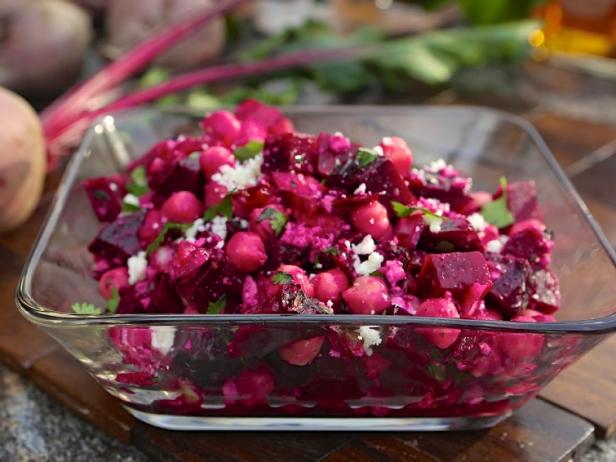
Roasted Beet Salad with Chickpeas and Red Onion


Yield:
4 servings
Level:
Easy


Ingredients


Directions

Preheat the oven to 350 degrees F.
Set the beets, garlic and rosemary on a large piece of aluminum foil. Drizzle with 1 tablespoon of the olive oil, sprinkle with some salt and pepper and add a splash of water. Fold the foil up into a pouch and seal the edges. Transfer to the oven and cook until the beets are easily pierced with a knife, 45 to 50 minutes. When done, remove the beets from the pouch and set them aside until cool enough to handle. With a paper towel rub the skins from the beets. Cut the peeled beets into bite-size cubes. Mince the roasted garlic.
Combine the beets, garlic, chickpeas, red onion, pickles and lemon juice in a bowl. Season with salt and pepper, drizzle with the remaining 2 tablespoons olive oil and toss to mix. Transfer the salad to a serving platter. Sprinkle with the cotija and cilantro and serve.

Source:  http://www.foodnetwork.com/recipes/guy-fieri/roasted-beet-salad-with-chickpeas-and-red-onion-2418914


New intern works on educating youth on food system issues

Name:  Becky Tierney

Town of residence:  Canton, NY – from Franklin, MA

Role at GardenShare:  As an intern, my primary responsibility is to reach out to youth in the St. Lawrence County community and spread the mission of GardenShare through education. I am creating another lesson plan for GardenShare’s repertoire on youth education and will be assessing the effectiveness of this new plan through survey.

How long?  I am interning at GardenShare from the month of September through December of 2017.

Why I do what I do:  I applied to be an intern at GardenShare because as an environmental studies major, I believe that one of the major ways we can mitigate climate change is by being mindful consumers and supporting local, small businesses rather than large franchises. GardenShare promotes local agriculture and emphasizes the importance nutritionally, economically, and environmentally of buying and eating local.

Role outside of GardenShare:  Outside of GardenShare, I am a full-time student at St. Lawrence University and will be graduating with a Bachelor’s in Environmental Studies with a French Minor in the spring of 2018. At St. Lawrence, I work for the Calling All Saints team as a student-caller and am a member of the Laurentian Singers.

Hobbies:  Singing, dancing, drawing and writing.

Most recent accomplishment:  I have just recently returned from studying abroad in Australia where I learned about the environmental management of the Great Barrier Reef and the marine park in which it lies. I hope to work in environmental management and in educating others on how their choices and actions impact their environment. Through GardenShare, I hope to develop my communication and organizational skills so that I can learn more about the food system within St. Lawrence County and educate its youth about GardenShare’s mission of eating locally and mindfully.

Favorite song, book, or movie?  My favorite song is Green Eyes by Coldplay.

Last read?  Small is Beautiful by E. F. Schumacher


Thursday, September 28, 2017

Another student joins the team

Name: Lindsay Campbell

Town of Residence: Hamilton, Massachusetts

Role at GardenShare: Volunteer

How long? Just starting a 4 month commitment

Why I do what I do: I am at GardenShare to help those who are in need and to help make sure everyone has access to healthy locally grown food.  


I am a freshman at St. Lawrence University, currently pursuing a degree in Business, but I am ultimately undecided. My favorite movie is Just Go With it, starring Adam Sandler and Jennifer Aniston. If I could be a superhero, my power would to be have super speed, so I can get things done faster. For example, homework, helping people, and just everyday tasks. One word I would use to describe myself is fun and funny. I like to make the most of every moment and use humor in my everyday life. What not many people know about me is that I have five siblings, one older sister, one older brother, and three younger sisters.  

Volunteers, donors, friends...

Canton Farmers Market Manager 
Jenn Whittaker
The leaves are starting to change, the air growing crisp, so it may feel like summer is drawing to a close. But things aren’t winding down at area farmers markets. You’ll surely still see Jenn Whittaker at the Canton Farmers Market every Tuesday and Friday throughout October.

Jenn is Canton’s market manager, and she is also a vital GardenShare volunteer and supporter. She serves as co-chair of our Outreach and Education Committee, and Jenn and Erik are members of our Sustainers’ Circle.

The Whittakers have long been interested in issues related to food policy and systems. “I’ve always been interested in how food gets to our plates,” says Jenn. But their interest became more personal and focused when their children, Arianna (15) and Braden (12), each developed substantial food allergies. “It became even more important for us to understand where our food comes from, how it is produced.”

It’s all in the family! Arianna (center) 
and friends provide music entertainment 
at the farmers market.
The Whittakers first became aware of GardenShare when they moved to Canton from the Malone area about seven years ago. “We had friends who were involved, and we were given a Local Food Guide to help us know where to find locally grown food.” She also remembers being delighted to find that she could use her credit or debit card to buy tokens to purchase produce at the farmers market.

As she learned more, she decided to get more involved. “This work is incredibly important,” says Jenn. “Food is a necessity, people can’t choose if they want to eat.” Jenn joined the O&E Committee, the kids pitch in helping at the farmers market and stuffing newsletters, and they all joined in the fun creating a float and representing GardenShare in Canton’s Dairy Princess parade.

Erik and Braden marching for 
GardenShare in veggie costumes 
in the Dairy Princess parade!
Erik and Jenn are GardenShare Sustainers, meaning they have made a three- year financial pledge to support the organization. “It’s just so important the people aren’t hungry,” says Jenn with her characteristic passion. “GardenShare brings people together and builds partnerships to solve issues of poverty and hunger. For us it’s a starting point to strengthen our community in our food justice efforts,” she says. “That’s why it’s so important to us to support and contribute to GardenShare’s work.”


It’s friends like the Whittaker family whose support and hard make GardenShare’s work possible in so many ways.

ADULTS WITH DISABILITIES AT HIGHER RISK OF FOOD INSECURITY


New research finds that adults with disabilities—mental health disabilities in particular—are at an increased risk of living in a household that is food insecure. Working-age adults have higher odds of food insecurity than young adults; older adults have lower odds of food insecurity than young and working-age adults. Some of these differences may be explained by the different levels of access such populations have to government programs such as employment services, Supplemental Security Income, and Social Security. The analysis showed that adults with a mental health disability were three to five times more likely to live in a food-insecure household, depending on age, than demographically similar adults without a disability. Mental health disabilities were the only type of disability that resulted in a significantly higher likelihood of food insecurity for all age groups considered.

Source: USDA, 9/5/17, Disability & Food Insecurity